
Invisalign vs Braces: Choosing Your Path to a Perfect Smile

Understanding the Technology: How Each System Straightens Teeth

Invisalign vs braces are the two most popular ways to straighten teeth — and choosing between them is one of the most common questions people have before starting orthodontic treatment.
Here's a quick side-by-side answer:
| Factor | Invisalign | Traditional Braces |
|---|---|---|
| Appearance | Nearly invisible | Visible metal or ceramic |
| Removable | Yes | No |
| Best for | Mild to moderate cases | Mild to severe/complex cases |
| Average treatment time | 12-18 months | 18 months to 3 years |
| Oral hygiene | Easy — remove to brush | Requires extra tools and care |
| Food restrictions | None | Several (sticky, hard foods) |
| Compliance required | Yes — 20-22 hrs/day | No — fixed to teeth |
| Comfort | Smooth plastic, no poking | Can irritate soft tissue |
Neither option is universally better. The right choice depends on the complexity of your case, your lifestyle, and how consistently you can wear removable aligners.
Both treatments are FDA-approved for correcting crooked teeth, crowding, gaps, and bite issues. Invisalign works well for roughly 90% of orthodontic cases. Traditional braces can handle virtually all cases, including the most complex.
The dentists at Advanced Smiles Marion bring extensive training and hands-on experience helping patients navigate the Invisalign vs braces decision — matching each person to the treatment that fits their smile goals and daily life. If you keep reading, you'll get a complete picture of how both options compare across cost, comfort, effectiveness, and more.
When we talk about invisalign vs braces, we are really talking about two different philosophies of physics. Both systems apply constant, gentle pressure to move teeth into a healthier alignment, but the "how" is where things get interesting. At Advanced Smiles Marion, we use high-tech digital tools to map out these movements before you even begin.
Traditional braces have been the gold standard since the late 1800s. They utilize metal or ceramic brackets bonded to the teeth with a specialized resin cement. These brackets act as anchors for an archwire, which is held in place by tiny elastics called ligatures. By adjusting these wires periodically, we create the tension needed to guide teeth into place.
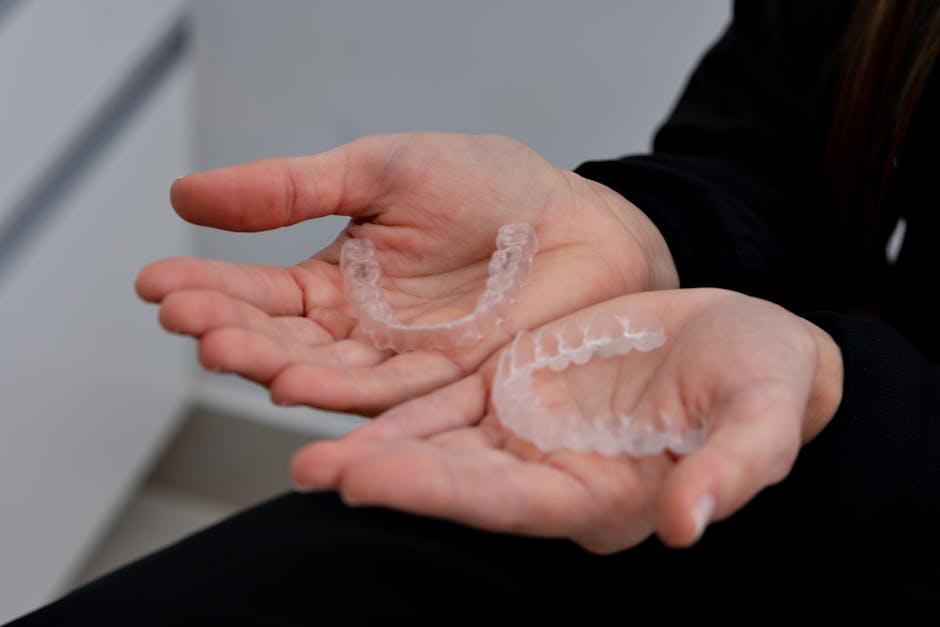
Invisalign, introduced in the late 90s, flipped this concept on its head. Instead of pulling teeth with wires, it pushes them with a series of custom-made, clear plastic trays. More info about Invisalign reveals that these trays are engineered using Patented SmartTrack technology, a medical-grade thermoplastic material designed specifically for a more comfortable fit and more predictable tooth movement.
The Science of Clear Aligners
The magic of Invisalign starts with a digital impression. We use an intraoral scanner to create a precise 3D model of your mouth—no messy putty required! This data allows us to plan every single tooth movement from start to finish.
You receive a series of sequential trays, each slightly different from the last. As you move from one tray to the next (usually every 1 to 2 weeks), your teeth gradually shift. For this technology to work, you must be disciplined; the aligners need to be in your mouth for 20-22 hours every day. However, research on faster treatment times with aligners suggests that for many patients, this digital precision can actually lead to shorter time in the dentist's chair compared to traditional methods.
Traditional Brackets and Wires
Braces are a fixed appliance, meaning they are working 24/7 without you having to think about them. This is often a relief for patients who worry they might forget to put their aligners back in after lunch!
Modern braces are much sleeker than the "train tracks" of the past. We offer stainless steel options as well as ceramic brackets that blend in with your natural tooth color. Because they are physically attached to the teeth, they provide a level of mechanical leverage that is incredibly effective for rotating stubborn teeth or making significant vertical movements.
Key Differences in Lifestyle and Aesthetics
Choosing between invisalign vs braces often comes down to how you spend your Tuesday afternoon. Do you have a big presentation? Are you a frequent snacker? Your daily habits play a huge role in which path is the "perfect" one for you.
| Feature | Invisalign | Traditional Braces |
|---|---|---|
| Daily Cleaning | Rinse aligners, brush teeth normally | Specialized flossing and brushing around wires |
| Eating | Remove trays; eat anything | Avoid sticky, hard, or crunchy foods |
| Visibility | Virtually invisible | Noticeable (unless using ceramic/lingual) |
| Maintenance | Switch trays at home | Monthly in-office adjustments |
Appearance and Comfort: The Aesthetic Appeal of Invisalign vs Braces
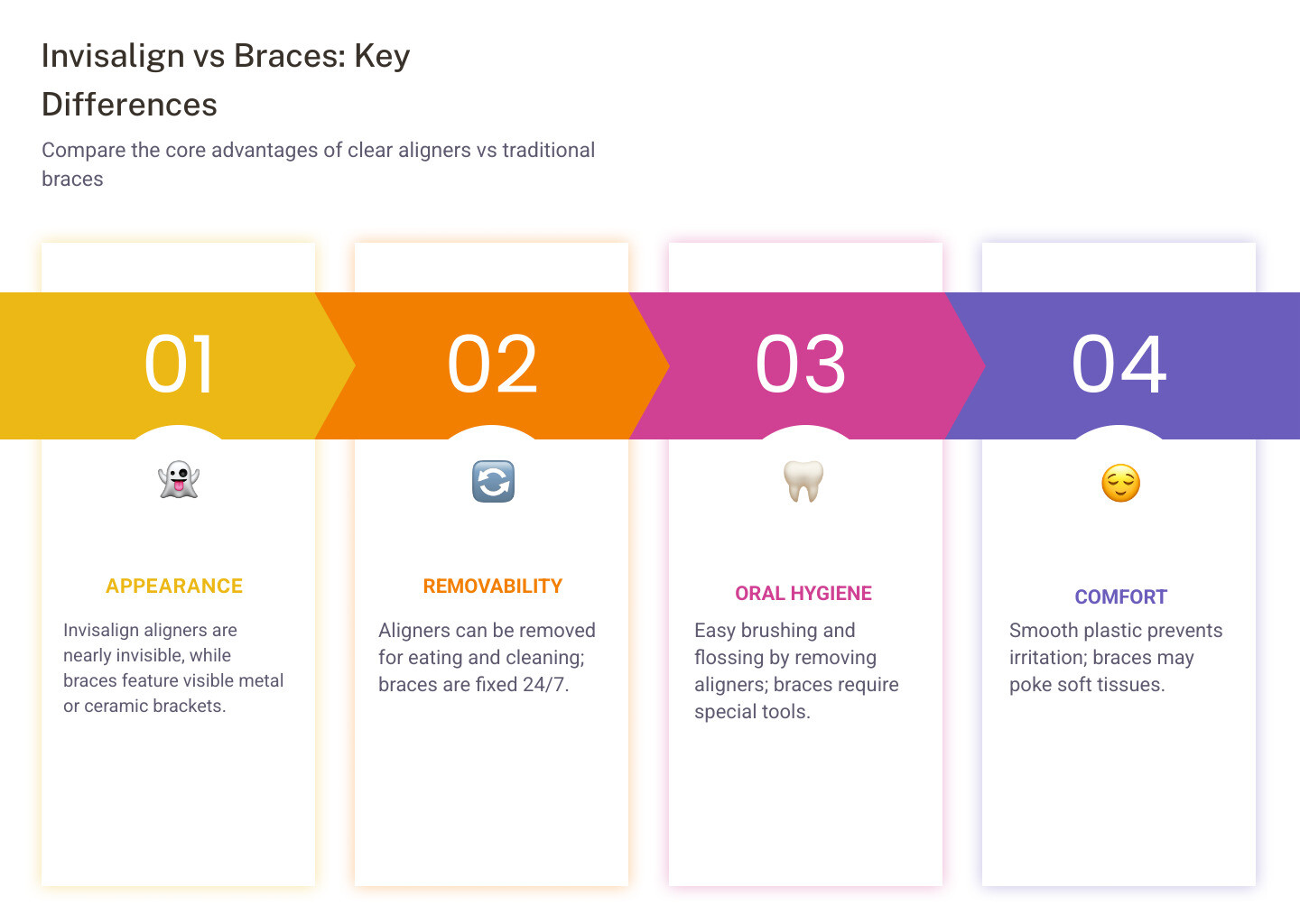
For many adults and self-conscious teens, the biggest draw of Invisalign is that it is virtually invisible. You can smile in photos and speak in meetings without anyone realizing you are undergoing orthodontic work. The smooth plastic is also generally kinder to the soft tissues of your mouth, avoiding the "poking wire" syndrome that can sometimes occur with braces.
However, it’s important to note that some patients require attachments. These are tiny, tooth-colored "bumps" of bonding material that give the aligner something to grip. While still discreet, they make the aligners slightly more visible. Braces, while more noticeable, offer a low-profile design today that minimizes lip irritation. If you're Ready for Your Smile Transformation?, we can help you weigh how much visibility matters to you.
Oral Hygiene and Dietary Freedom
This is usually where Invisalign wins the popularity contest. Because the trays are removable, you have total dietary freedom. You can still enjoy popcorn, apples, and sticky taffy—just take your aligners out first.
Cleaning is also much simpler. You just brush and floss your teeth like you always have. With braces, brushing and flossing with braces requires a bit more dedication. You'll need to use interdental brushes or water flossers to get behind the archwires to prevent plaque buildup and staining.
Clinical Effectiveness and the Cost of Invisalign vs Braces
While lifestyle is important, we also have to look at the clinical reality of your smile. Some "bite" issues are like a simple puzzle, while others are more like a complex architectural project.
Treating Mild vs. Complex Orthodontic Issues
Invisalign is a powerhouse for treating mild to moderate crowding, gaps, and certain types of overbites or underbites. It is suitable for about 90% of cases we see. However, for severe malocclusions—such as teeth that need to be rotated significantly or cases involving skeletal changes—braces often offer more precision control.
A study on treating complex cases with fixed appliances confirms that braces provide a level of predictability that plastic aligners sometimes struggle to match in very difficult scenarios. Some Orthodontists Don't Want You Knowing This Teeth Straightening Secret, but the truth is that the "best" system is the one that can actually achieve the result you want. Sometimes, we even suggest starting with braces and switching to Invisalign once the heavy lifting is done!
Comparing the Financial Investment
When looking at the typical Invisalign cost, many patients are surprised to find it is very comparable to traditional braces. In the United States, orthodontic treatment generally ranges from $3,500 to $9,500.
Factors that influence the price include:
- The complexity of the alignment needed.
- The length of the treatment time.
- Your insurance coverage (many plans now cover Invisalign the same way they cover braces).
At Advanced Smiles Marion, we believe a beautiful smile should be accessible. As a premier Orthodontist in Marion Ohio, we offer flexible financing and wellness plans to help fit this investment into your budget.
The Treatment Journey: From Consultation to Retainers
Whether you choose invisalign vs braces, the journey starts the same way: with a conversation. During your initial consultation, we’ll take X-rays and scans to determine which path is best for your unique anatomy.
Average treatment times:
- Invisalign: 12–18 months (can be as short as 6 months for minor cases).
- Braces: 18 months to 3 years.
The most common reason for an Invisalign treatment taking longer than expected is compliance. If the trays aren't in your mouth, they aren't moving your teeth! Braces, being fixed, offer a more predictable timeline for those who might struggle with the discipline of removable aligners.
Once the active phase of treatment is over, the work isn't quite done. Maintaining results with retainers is the only way to ensure your teeth don't shift back to their old positions. Whether it's a clear plastic retainer or a permanent wire behind your teeth, lifelong stability is the goal.
Frequently Asked Questions about Invisalign vs Braces
Is Invisalign vs Braces the Right Choice for My Case?
The "right" choice is a blend of clinical need and personal discipline. If you have a severe bite issue, braces are likely the answer. If your issues are moderate and you are a professional who prioritizes aesthetics, Invisalign is a fantastic fit. We provide a thorough Invisalign vs Braces: A Comparison of Costs, Pros, and Cons during our evaluations to help you decide.
Which treatment is faster for minor crowding?
For minor crowding or small gaps, Invisalign often takes the lead. We offer "Express" options that can sometimes see results in as little as 3 to 6 months. However, this speed depends entirely on your biological response and your commitment to wearing the trays 22 hours a day.
Do insurance plans cover both options equally?
Most modern dental insurance plans that include orthodontic benefits treat Invisalign and braces the same. They typically pay a "lifetime maximum" amount toward the treatment. Our team at Advanced Smiles Marion is happy to help you navigate your specific provider network to minimize your out-of-pocket costs.
Conclusion
At Advanced Smiles Marion, we are more than just a dental office; we are your partners in health. Our highly educated team is deeply involved in the latest dental advancements, ensuring you receive world-class care right here in Marion, OH.
Beyond straightening teeth, we focus on your total wellness. We feature cutting-edge laser treatments for TMJ pain, canker sore healing, and periodontal disease. For those without insurance, our Dental Wellness Plan offers a way to get yearly care—including two fluoride treatments a year—at a discounted price.
Whether you need a routine check-up, endosteal dental implants (averaging about $4500 per tooth), or find yourself in a "same-day" dental emergency, we are here for you. Ready to see which path is right for you? Start your journey with Invisalign or braces by booking your consultation with us today. Your perfect smile is closer than you think!
Get in touch
Have any questions? Want to learn more?


