
Everything You Need to Know About Treating Periodontal Disease

What Is Gum Disease Treatment — and Do You Actually Need It?

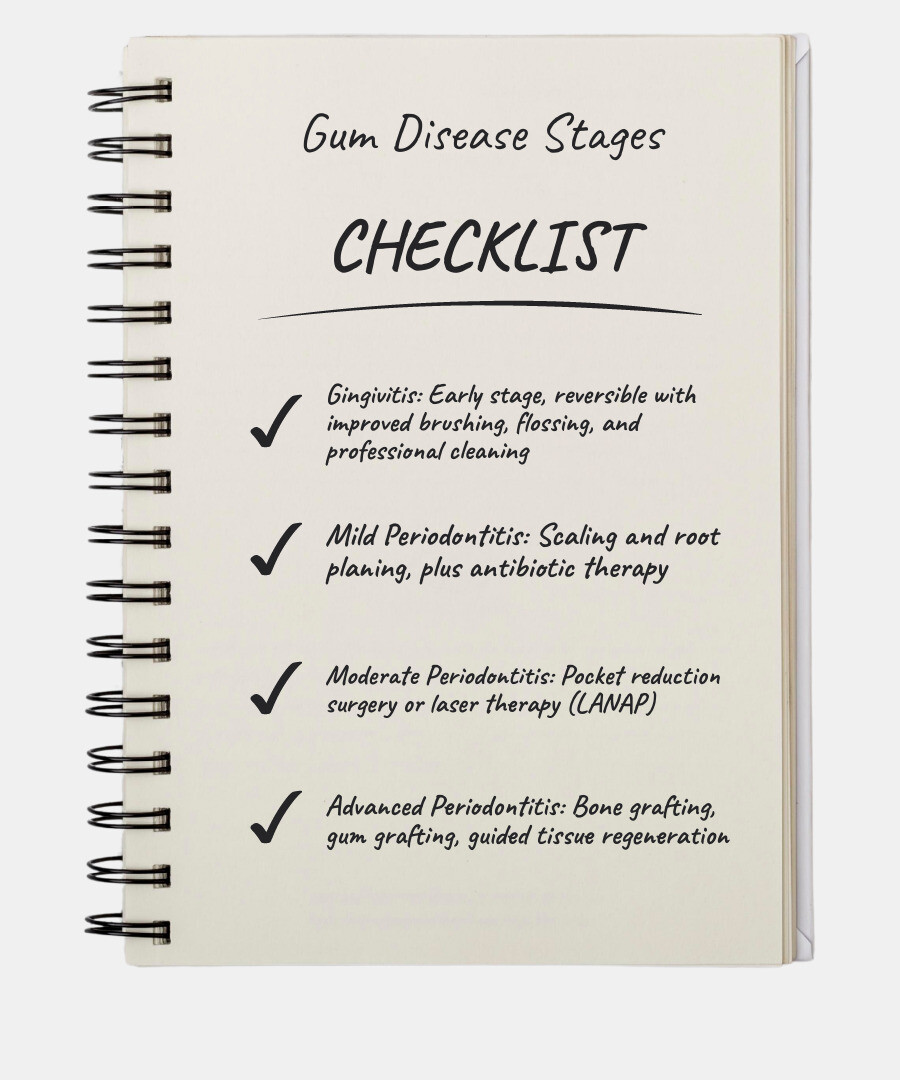
Gum disease treatment covers a range of options depending on how advanced the disease is:
| Stage | Treatment Options |
|---|---|
| Gingivitis (early) | Improved brushing, flossing, professional cleaning |
| Mild periodontitis | Scaling and root planing, antibiotic therapy |
| Moderate periodontitis | Pocket reduction surgery, laser therapy (LANAP) |
| Advanced periodontitis | Bone grafting, gum grafting, guided tissue regeneration |
The good news? When caught early, gum disease is fully reversible. The earlier you act, the simpler — and less costly — the treatment.
Gum disease is far more common than most people realize. Around 4 in 10 U.S. adults over 30 have some level of periodontitis. Many don't even know it, because it often develops without pain in the early stages. By the time symptoms become obvious, real damage may already be underway.
The cause is straightforward: bacteria in your mouth form a sticky film called plaque. If plaque isn't removed regularly, it hardens into tartar — something only a dental professional can clean off. Over time, this buildup irritates the gums, causes inflammation, and eventually attacks the bone supporting your teeth.
The dentists at Advanced Smiles Marion bring advanced training and a genuine commitment to staying current with the latest in gum disease treatment — including cutting-edge laser therapy. Understanding your options is the first step toward healthier gums.
Essential Gum disease treatment terms:
Recognizing the Signs and Symptoms of Gum Disease
Because gum disease often progresses silently, you have to be a bit of a detective with your own oral health. The earliest stage, gingivitis, is characterized by inflammation. You might notice your gums looking redder than usual or feeling a bit puffy.
One of the most common "red flags" is seeing blood in the sink when you brush or floss. Healthy gums do not bleed. If yours do, it’s a sign that bacteria are irritating the tissue. Another hallmark symptom is halitosis, or persistent bad breath. This isn't just "garlic breath" from lunch; it’s caused by bacteria releasing foul-smelling toxins as they feed on plaque.
As the disease progresses into periodontitis, the symptoms become more structural. You might notice:
- Receding gums: Your teeth may look "longer" because the gum tissue is pulling away.
- Tooth sensitivity: As gums recede, they expose the sensitive dentin of the tooth root, making cold drinks or a breath of chilly Marion air feel like a sharp shock.
- Loose or shifting teeth: This is a serious sign that the bone supporting your teeth is being destroyed.
- Pus between teeth: A sign of active infection or an abscess.
If you are experiencing these symptoms of gum disease, it is vital to seek professional help immediately. At Advanced Smiles Marion, our highly educated dentists use precision diagnostics to determine exactly how far the disease has progressed.
Nonsurgical Gum Disease Treatment Options
For many of our patients in Marion, OH, we can manage or even reverse gum issues without ever picking up a scalpel. Nonsurgical gum disease treatment is the first line of defense for gingivitis and mild-to-moderate periodontitis.
The gold standard for nonsurgical care is scaling and root planing. Think of this as a "deep cleaning" that goes far beyond a standard six-month checkup. During scaling, we remove plaque and tartar from above and below the gumline. Root planing involves smoothing out the rough spots on the roots of your teeth. This is crucial because bacteria love to cling to rough surfaces; smoothing them makes it harder for plaque to reattach and allows your gums to heal and reattach to the tooth.
We also utilize antibiotic therapy. Sometimes, we place localized antibiotics directly into the "pockets" between your teeth and gums to kill stubborn bacteria. In other cases, a specialized mouthwash or a short course of oral antibiotics might be prescribed.
A major part of nonsurgical success happens at home. We often recommend a water flosser for patients struggling with traditional floss. Clinical studies show that water flosser users can see up to a 74.4% reduction in whole-mouth plaque compared to traditional flossing.
| Feature | Manual Dental Floss | Water Flosser |
|---|---|---|
| Plaque Reduction | Approx. 57.7% | Approx. 74.4% |
| Ease of Use | Requires manual dexterity | Point and spray |
| Reach | Hard to reach back teeth | Excellent for tight spaces |
| Gum Health | Can be abrasive if used wrong | Massages gums, reduces bleeding |
For more details on how we keep these procedures comfortable and effective, check out our resource on affordable gum disease care.
The Role of Laser Gum Disease Treatment
At Advanced Smiles Marion, we pride ourselves on being at the forefront of dental technology. One of our most exciting offerings is laser gum disease treatment. Using specialized dental lasers, we can target and vaporize diseased tissue and bacteria without harming the healthy gum tissue surrounding it.
Laser therapy is a game-changer because it is minimally invasive. There are no incisions and usually no need for sutures. This means significantly less swelling, less bleeding, and a much faster recovery time. Beyond treating infection, we also use laser treatments for:
- TMJ pain relief: Reducing inflammation in the jaw joint.
- Canker sore healing: Speeding up the recovery of painful mouth sores.
- Tissue regeneration: Stimulating the body’s natural ability to heal and regrow healthy attachments.
Professional Maintenance and Gum Disease Treatment
Even after successful treatment, gum disease requires lifelong vigilance. Periodontitis is a chronic condition; while we can stop the infection and manage the damage, the susceptibility remains. This is why regular hygienist visits are non-negotiable.
Our hygienists are experts at tartar control. Once plaque hardens into tartar (calculus), no amount of brushing at home will remove it. We use professional-grade tools to keep these deposits at bay.
To make this ongoing care more accessible, we offer the Dental Wellness Plan. This is specifically designed for our Marion neighbors who don't have traditional dental insurance. For a discounted price, the plan covers your yearly preventive care, including exams, cleanings, and now two fluoride treatments per year to help strengthen your enamel and protect against decay. It’s our way of ensuring that world-class gum disease treatment stays within reach for every family.
Advanced Surgical Procedures for Periodontitis
When gum disease reaches an advanced stage, nonsurgical methods may not be enough to save the teeth. In these cases, our dentists may recommend surgical intervention to repair the damage and prevent tooth loss.
One common procedure is pocket reduction surgery (also known as flap surgery). We gently lift the gums back to remove deep-seated tartar and then secure the tissue back in place so it fits snugly around the tooth, making it easier to keep clean.
If the disease has destroyed the bone or gum tissue, we turn to regenerative techniques:
- Bone Grafting: We use fragments of your own bone, synthetic bone, or donated bone to replace what was lost. This provides a stable foundation for your teeth.
- Gum Grafting: To treat severe recession, we can take tissue (often from the roof of your mouth) and attach it to the areas where gums have worn away.
- Guided Tissue Regeneration (GTR): We place a small piece of mesh-like fabric between the bone and gum tissue. This prevents the fast-growing gum tissue from moving into the space where bone should be, giving the slower-growing bone time to regenerate.
- PRF/PRP: We can use Platelet-Rich Fibrin or Plasma derived from your own blood to accelerate healing and reduce recovery times.
In cases where a tooth simply cannot be saved, we offer endosteal dental implants. These are titanium posts that act as artificial tooth roots. Our dentists are highly skilled in implant placement, providing a permanent, natural-looking solution for missing teeth. The average cost for a single-tooth implant at our practice is about $4,500. You can read more about the causes, symptoms, and treatment of periodontal disease to understand why these interventions are sometimes necessary.
Frequently Asked Questions about Periodontal Care
Is gum disease curable or just manageable?
This is a nuanced question. Gingivitis is 100% curable and reversible. If we catch it early, we can return your gums to a perfectly healthy state. However, once it progresses to periodontitis, the "cure" changes. Because periodontitis involves the permanent loss of the bone and ligaments that hold your teeth, we cannot "undue" that structural loss entirely. Instead, we focus on long-term management. We can stop the infection, heal the inflammation, and even rebuild some tissue, but you will always need to be extra diligent with your oral hygiene to prevent a relapse.
How does diabetes affect gum health?
There is a "two-way street" relationship between diabetes and gum disease. People with diabetes are more susceptible to infections, including periodontal disease. High blood sugar can weaken white blood cells, which are your body's main defense against bacterial infections in the mouth. Conversely, serious gum disease can actually make it harder to control blood glucose levels because the body is constantly fighting inflammation. Managing your gum health is a vital part of managing your diabetes. For a deeper dive, you can listen to this research on periodontal disease and diabetes.
What happens if gum disease is left untreated?
The consequences of ignoring gum disease are severe. Locally, it leads to painful abscesses, bone destruction, and eventually, total tooth loss. However, the impact doesn't stay in your mouth. The bacteria from infected gums can enter your bloodstream, and research has linked chronic periodontal inflammation to systemic health issues like heart disease, stroke, and respiratory problems. Treating your gums is an investment in your entire body's health.
Conclusion
At Advanced Smiles Marion, we don't just treat teeth; we treat people. Our team of highly involved and continuously educated dentists uses the latest technology—from advanced lasers to digital dentures—to provide the best possible outcomes for our patients in Marion, OH.
Whether you need a routine wellness checkup, professional teeth whitening, or advanced gum disease treatment, we are here to provide personalized, world-class care. We also understand that dental issues don't always happen during business hours. That’s why we offer emergency dental treatments, often seeing patients on the same day they call.
Don't wait for pain to tell you there's a problem. If your gums are bleeding or you’re worried about your oral health, contact us today to schedule an appointment. For more information on how we care for every member of your household, visit our page on family dentistry services. Let us help you keep your smile healthy, functional, and beautiful for a lifetime.
Get in touch
Have any questions? Want to learn more?


