
The Truth About Getting Insurance to Pay for Your Veneers

Does Insurance Cover Veneers? Understanding the Cosmetic vs. Restorative Divide

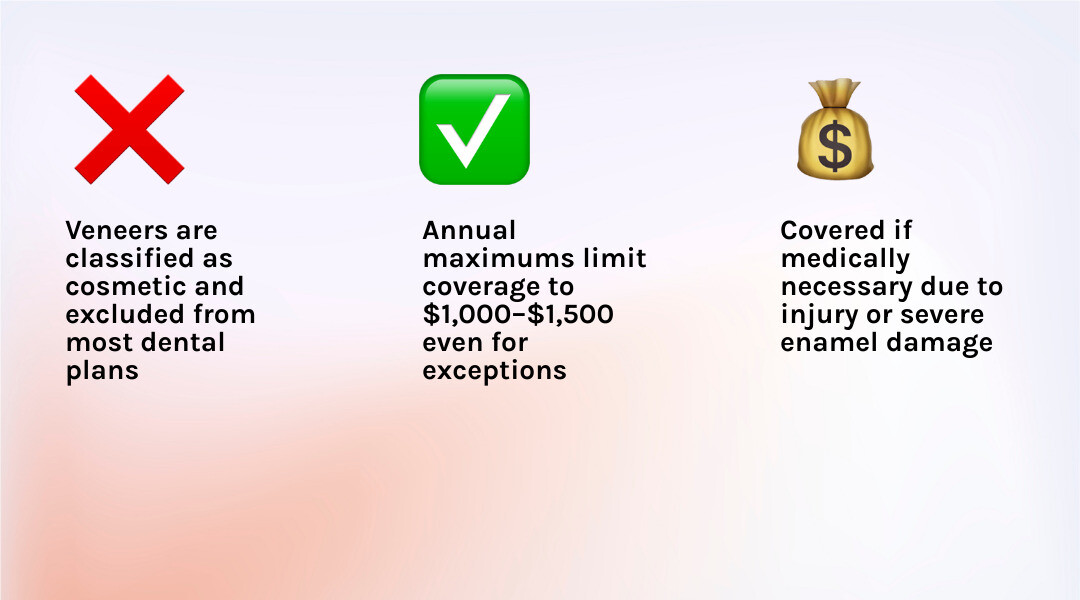
Does insurance cover veneers? In most cases, no — dental insurance typically excludes veneers because they are classified as a cosmetic procedure rather than a medically necessary one.
Here's the quick answer:
| Question | Answer |
|---|---|
| Does insurance usually cover veneers? | No — most plans exclude cosmetic procedures |
| Are there any exceptions? | Yes — if veneers are deemed medically necessary (e.g., injury, severe enamel loss) |
| What portion might be covered if medically necessary? | Partial coverage only; annual maximums of $1,000–$1,500 apply |
| What if my insurance won't cover them? | HSAs, FSAs, financing, and dental savings plans can help |
Most dental insurance plans are built around three tiers:
- Preventive care (cleanings, exams) — typically covered at or near 100%
- Basic restorative (fillings) — often covered at 70–80%
- Major restorative (crowns, root canals) — typically covered at around 50%
Veneers don't fit neatly into any of these tiers. Because they're primarily used to improve the appearance of teeth — fixing stains, chips, or minor misalignment — insurers label them elective. That means the cost falls almost entirely on you.
That said, there are situations where partial coverage is possible, and knowing how to navigate your plan can make a real difference.
At Advanced Smiles Marion, our highly educated dental team — trained to the highest standards and committed to ongoing professional development — works with patients every day on questions around does insurance cover veneers and how to make cosmetic care as affordable as possible. We'll walk you through your options clearly, so you can make a confident decision about your smile.
When you open your dental insurance handbook, you’ll likely see a lot of talk about "restorative" care. This is the insurance industry's way of saying they will help pay to fix a tooth that is broken, decayed, or missing. However, when it comes to the question, "does insurance cover veneers," the answer usually hits a wall because veneers are categorized as "cosmetic."
Cosmetic procedures are those performed solely to improve the aesthetic appeal of your smile. Since a stained or slightly crooked tooth can still chew food and function normally, insurance companies view the fix as elective. It’s a bit like car insurance: they’ll pay to fix your bumper after a fender bender, but they won't pay for a custom metallic paint job just because you think it looks better.
Most dental policies have a "Major Dental Work" category, which typically covers things like Dental Veneers only if they serve a restorative purpose. Even then, you have to navigate annual maximums—the total amount the insurance company will pay in a single year—which usually range from $1,000 to $1,500. If you have a $50 to $100 deductible, that also comes out of your pocket before the insurance kicks in a dime.
To better understand how insurance views different procedures, look at this breakdown:
| Procedure Type | Typical Insurance Coverage | Examples |
|---|---|---|
| Cosmetic | 0% | Veneers, Teeth Whitening |
| Restorative | 50% | Crowns, Bridges, Dental Implants |
| Basic | 70-80% | Fillings, Simple Extractions |
| Preventive | 100% | Cleanings, X-rays, Exams |
As you can see, Are Veneers Covered by Insurance: Exploring Coverage Options depends heavily on how your dentist codes the procedure and why you need it.
How can I check if my specific insurance covers veneers?
Navigating the fine print of an insurance policy can feel like trying to read ancient hieroglyphics. However, there are a few reliable ways to get a straight answer:
- Review Your Plan Documents: Look for sections labeled "Exclusions" or "Limitations." Most plans explicitly state that "cosmetic services" are not covered.
- Check Your Benefit Plan Document: This is the more detailed version of your summary. It will list whether veneers are covered under "Major Restorative" care.
- Talk to Our Insurance Coordinator: At Advanced Smiles Marion, we have experts who spend their days talking to insurance companies. We can call your provider on your behalf to get the specifics of your coverage.
- Request a Pre-Treatment Estimate: This is the gold standard. We submit a plan to your insurance company before we start any work. They send back an estimate showing exactly what they will pay and what your out-of-pocket cost will be.
What are common misconceptions about does insurance cover veneers?
One of the biggest myths we hear is that if a tooth is "ugly," insurance must cover it. Unfortunately, insurance companies don't have a "vanity clause." Another misconception is that "Full Coverage" insurance covers everything. In reality, "full coverage" usually just means you have preventive, basic, and major care—but cosmetic exclusions still apply.
Many patients also don't realize that even if a veneer is covered for a medical reason, there is often a "waiting period." If you just signed up for a new plan, you might have to wait 6 to 12 months before they will pay for major restorative work. Finally, some people believe that if insurance covers a crown, they will automatically cover a veneer. This isn't always true; insurance may only pay for the "least expensive professionally acceptable treatment," which might be a filling rather than a veneer.
When Veneers Might Be Considered Medically Necessary
While the general rule is "no coverage," there is a significant exception: medical necessity. If your veneers are being used to restore the function of your teeth rather than just their look, you might find some wiggle room.
When might this happen? Here are a few scenarios:
- Accidental Injury: If you took a tumble and cracked a front tooth, a veneer might be used to restore the tooth's structure.
- Severe Enamel Erosion: If your enamel has worn away due to acid reflux or other medical conditions, leaving the tooth sensitive and vulnerable to decay, a veneer acts as a protective shield.
- Structural Damage: Large chips or fractures that compromise the tooth’s integrity can sometimes qualify for restorative coverage.
In these cases, the insurance company views the veneer as a "restorative" treatment similar to a crown. However, proving this requires a lot of paperwork. Our team at Advanced Smiles Marion is highly skilled at providing the necessary clinical documentation, including X-rays and detailed narratives, to explain to the insurance company why the procedure is essential for your oral health.
According to How Much Do Veneers Cost? Pricing and Coverage Guide, obtaining pre-authorization is vital. Without it, you’re essentially guessing whether they’ll pay. It’s also worth noting the Veneers vs Crowns Expert Insights from Marions Top Dentists; sometimes a crown is a more "insurable" option for a badly damaged tooth because it provides 360-degree protection, whereas a veneer only covers the front.
The Real Cost of Veneers Without Insurance
If you find that your insurance won't budge, it’s time to look at the out-of-pocket reality. The cost of veneers varies wildly based on the material used and the number of teeth you're treating.
Porcelain vs. Composite Resin
There are two main players in the veneer world: porcelain and composite resin.
- Porcelain Veneers: These are the "luxury" option. They are custom-crafted in a dental lab to match the translucency and light-reflecting properties of natural enamel. They are incredibly stain-resistant and, with proper care, can last 15 years or more. Because they require lab fabrication and multiple visits, they are more of an investment.
- Composite Veneers: These are made of a tooth-colored resin (the same stuff used for fillings) and are often applied in a single visit. While they look great, they are more prone to staining and typically only last 5 to 7 years.
When researching the Average Cost for Dental Veneers, you get what you pay for. A full set of 6 to 8 veneers for a "smile makeover" is a significant commitment. Beyond the material, you’re paying for the expertise of the dentist and the precision of the dental lab.
Another factor is the Teeth Veneers Price vs. long-term value. If you choose composite to save money now but have to replace them twice as often, porcelain might actually be the cheaper option over a 20-year period. You also have to consider the Difference Between Veneers and Crowns; veneers are thinner (about 0.5mm to 1mm) and require less tooth reduction, which preserves more of your natural tooth structure.
Alternative Ways to Pay for Your Smile Transformation
At Advanced Smiles Marion, we believe that everyone deserves a smile they love, regardless of what their insurance company says. If the answer to "does insurance cover veneers" is a resounding "no" for your specific case, don't lose hope. We offer several ways to make treatment manageable.
The Advanced Smiles Marion Dental Wellness Plan
For our patients in Marion, OH, who don't have traditional dental insurance, we offer our own Dental Wellness Plan. This isn't insurance—it’s better. It’s a membership that allows individuals and families to get their yearly dental care for a discounted price.
Our plan includes:
- Two professional cleanings per year.
- Two fluoride treatments per year (to keep those natural teeth under your veneers strong!).
- All necessary X-rays and exams.
- Significant discounts on other services, including veneers, crowns, and even Endosteal dental implants.
Speaking of implants, if you are missing a tooth entirely, an endosteal dental implant is the gold standard for replacement, typically averaging about $4,500 for a single tooth.
HSA and FSA Funds
If you have a Health Savings Account (HSA) or a Flexible Spending Account (FSA) through your employer, you can often use these pre-tax dollars to pay for dental work. While some plans are strict about "purely cosmetic" work, if your dentist can document a functional need for the veneer (like repairing a chip), you can often use these funds to cover the Cost Dental Veneers.
Financing Options
We partner with third-party lenders like CareCredit to offer flexible payment plans. Many of these plans offer 0% interest for a set period, allowing you to break up the total cost into monthly payments that fit your budget.
Are there cheaper alternatives if insurance doesn't cover veneers?
If veneers are currently out of reach, we can explore other options to brighten your smile:
- Tooth Bonding: This uses composite resin to fix small chips or gaps. It’s much more affordable than veneers and can often be done in one visit. Check out our guide on Cost Dental Bonding vs Veneers to see which fits your budget.
- Teeth Whitening: Sometimes, a professional whitening treatment is all you need to fall in love with your smile again.
- Invisalign: If your main concern is crooked teeth, Invisalign can straighten them without the need for porcelain shells.
- Resin Bonding vs Veneers Which is Right for You: This is a common debate for our patients. Bonding is great for minor fixes, while veneers are better for a total transformation. Read more about it here.
Frequently Asked Questions About Veneer Coverage
Do most dental plans have an annual maximum for veneers?
Yes. Almost every dental insurance plan has an annual maximum benefit, which is the most they will pay for all your dental care in a plan year. This is usually between $1,000 and $1,500. Even if your insurance agrees that your veneers are medically necessary and offers to pay 50%, they will stop paying once you hit that $1,500 limit. You are responsible for the remaining balance. The good news? The "clock" usually resets every January 1st, so some patients choose to split their treatment across two years to maximize their benefits.
Can I use a dental savings plan for veneers?
Absolutely. Dental savings plans (or discount plans) are an excellent alternative to insurance. You pay an annual membership fee and get access to a network of dentists who have agreed to offer their services at reduced rates. These plans often provide 20% to 60% off procedures like veneers. Unlike insurance, there are usually no waiting periods and no "medical necessity" hurdles to jump over. You sign up, and you can start saving immediately.
Is the veneer procedure irreversible?
This is a crucial point to understand. To ensure the veneer sits flush with your other teeth and doesn't look "bulky," we typically have to remove a very thin layer of enamel (about the thickness of a fingernail). Because enamel does not grow back, this makes the procedure permanent. Once you get veneers, you will always need some form of covering on those teeth. This is why we emphasize that veneers are a long-term commitment. However, most of our patients find the results so life-changing that they never look back!
Conclusion: Achieving Your Best Smile at Advanced Smiles Marion
Navigating dental insurance can be frustrating, but you don't have to do it alone. At Advanced Smiles Marion, we combine clinical excellence with a warm, patient-first approach. Our dentists are among the most highly educated in the field, staying at the forefront of dental technology to ensure you receive the best care possible.
We aren't just about veneers and crowns; we're about your total wellness. We feature advanced laser treatments for:
- TMJ Pain: Relief for those suffering from jaw tension and headaches.
- Canker Sore Healing: Drastically reducing the pain and healing time of annoying sores.
- Periodontal Disease: Using lasers to treat gum disease more comfortably and effectively.
And if you ever find yourself in a bind, we offer emergency dental treatments. We understand that dental pain doesn't follow a schedule, which is why we are able to see most emergency patients on the same day.
Whether you're looking for a total smile makeover with Dental Veneers or just need a reliable home for your family's oral health, we are here for you in Marion, OH. Don't let questions about "does insurance cover veneers" stand in the way of your confidence. Reach out to us today, and let’s create a plan that works for your smile and your budget.
Get in touch
Have any questions? Want to learn more?


