
Decoding D2710: A Deep Dive into Crown Delivery Codes

What Are CDT Codes and Why Do They Matter for Your Crown?
Understanding the ada code for crown delivery is crucial for navigating dental insurance and making informed decisions about your oral health. Here are the key crown delivery codes you need to know:
Primary Crown Codes:
- D2740 - Porcelain/Ceramic Crown (most common for front teeth)
- D2750-D2752 - Porcelain-Fused-to-Metal Crown (strength + appearance)
- D2790-D2792 - Full Metal/Gold Crown (maximum durability)
- D2780-D2783 - Partial Coverage Crowns (conservative option)
- D2971 - Provisional Crown (temporary protection)
CDT codes are standardized procedural identifiers developed and maintained by the American Dental Association. These codes provide dentists a means to document services delivered to patients and facilitate communication between dental professionals, patients, and insurance providers.
Why do these codes matter to you as a parent? Simple - they directly impact your insurance coverage and out-of-pocket costs. Understanding CDT codes for dental crowns not only helps with insurance claims but also empowers patients to make informed decisions about their oral health.
When your dentist recommends a crown for your child or yourself, knowing the difference between D2740 (ceramic) and D2750 (porcelain-fused-to-metal) helps you understand both the treatment approach and expected insurance benefits. The ada code for crown delivery varies based on the material used, extent of tooth coverage, and preparation techniques.
At Advanced Smiles Marion, our highly educated and professionally involved dentists help families steer these coding complexities while providing exceptional care. With extensive training and commitment to continuing education, our team ensures you understand every aspect of your treatment, including how the ada code for crown delivery affects your dental investment.
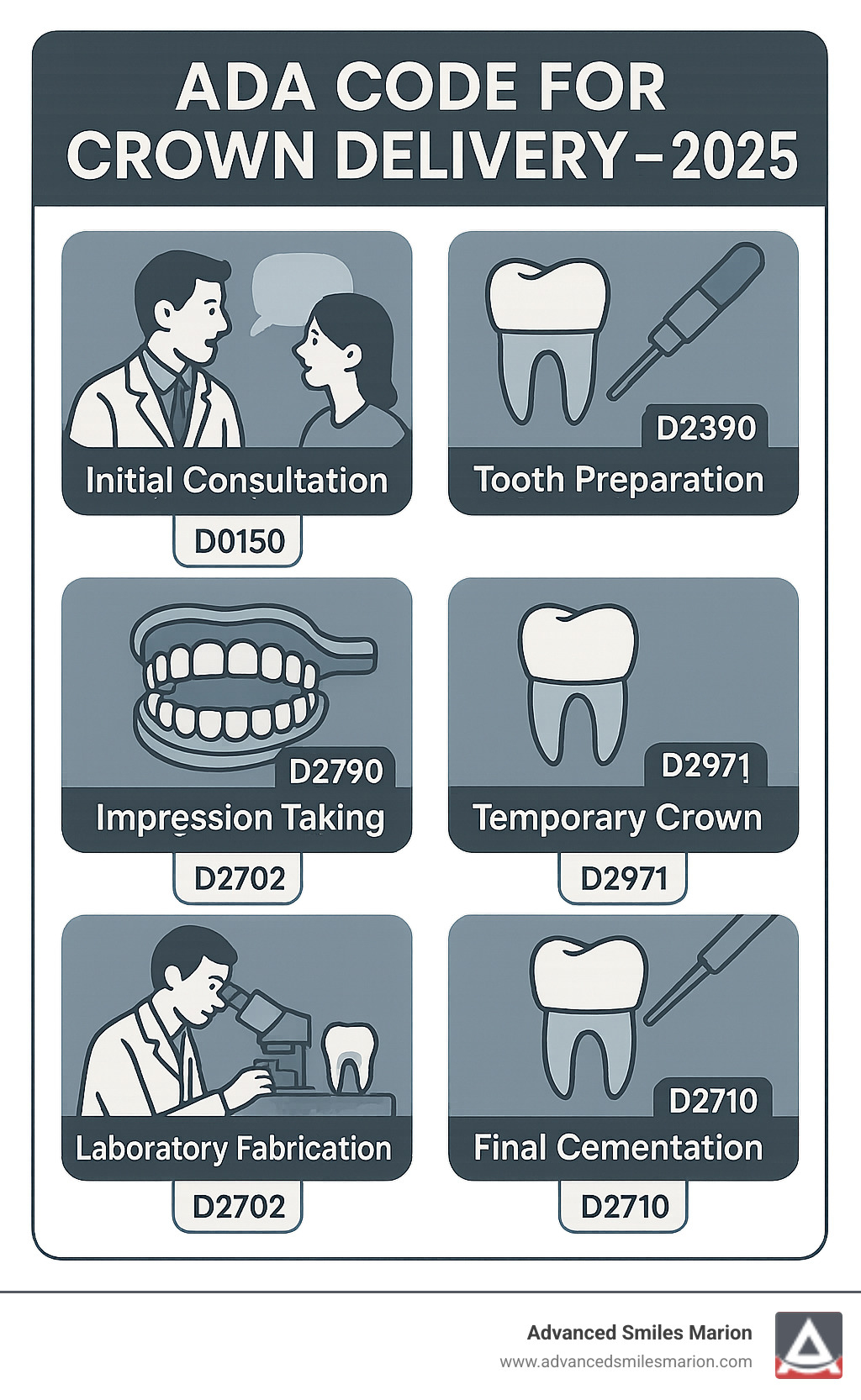
Must-know ada code for crown delivery terms:
When is a Dental Crown Necessary?
Think of a dental crown as a protective helmet for your tooth. When your natural tooth has been through a lot - whether from decay, injury, or wear - a crown steps in to restore both function and appearance.
Extensive decay is one of the most common reasons we recommend crowns. When a cavity grows too large for a regular filling to handle effectively, the ada code for crown delivery becomes relevant to your treatment plan. At this point, your tooth needs more comprehensive protection than a simple filling can provide.
A cracked tooth might seem like a minor issue, but it can quickly become a major problem. Cracks allow bacteria to enter, potentially leading to infection or further fracturing. A crown acts like a strong band, holding everything together and preventing the crack from spreading.
After root canal treatment, your tooth becomes more fragile since we've removed the inner pulp that kept it vital. Without a crown to protect it, the tooth could easily break under normal chewing pressure. This is why crowns and root canals often go hand-in-hand in treatment planning.
When you have large fillings that take up a significant portion of your tooth, the remaining natural structure can become weak. Rather than waiting for the tooth to break, a crown provides the strength and stability your tooth needs to function properly for years to come.
Sometimes crowns serve a cosmetic improvement purpose, especially for front teeth where appearance matters most. Whether you're dealing with severe discoloration, misshapen teeth, or significant chips, crowns can transform your smile while providing structural support.
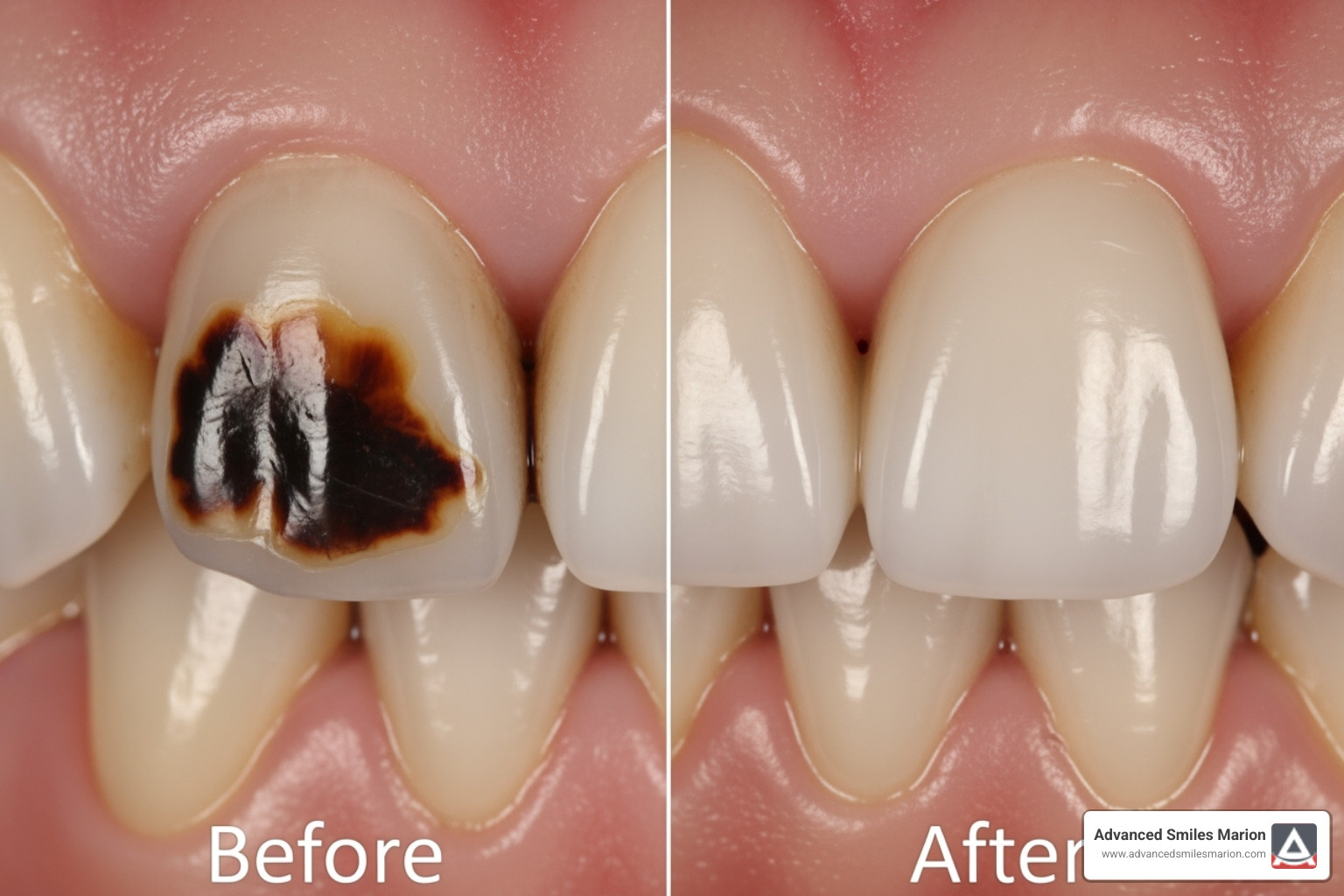
The highly educated dentists at Advanced Smiles Marion carefully evaluate each situation to determine when a crown is truly necessary versus when other treatments might be more appropriate. Our team's extensive training and commitment to continuing education means we can help you understand exactly why a crown might be the best solution for your specific situation.
For a deeper understanding of what crowns can do for your smile, check out our comprehensive guide on Dental Crowns Explained: Benefits, Risks, and Costs.
Cracking the Code: A Guide to the ADA Code for Crown Delivery
Understanding the ada code for crown delivery can feel like learning a secret language, but it's actually quite straightforward once you know what each code represents. These CDT codes help your dentist communicate with insurance companies about exactly what type of crown you're receiving - and more importantly for you, they determine how much coverage you'll get.
The main difference between crown codes comes down to three key factors: what material is used, how much of your tooth gets covered, and whether it's going on a front tooth or back tooth. Think of it like ordering a custom suit - the tailor needs to know the fabric, the style, and where you'll be wearing it.
| Crown Material Type | Primary CDT Code | Typical Use (Anterior/Posterior) | Key Benefits (Aesthetics vs. Strength) |
|---|---|---|---|
| Porcelain/Ceramic | D2740 | Anterior (front teeth) | High aesthetics, natural appearance |
| Porcelain-Fused-to-Metal | D2750-D2752 | Both, often posterior | Good aesthetics, strong, durable |
| Full Metal/Gold | D2790-D2792 | Posterior (back teeth) | Maximum durability, longevity |
| Resin (Indirect) | D2710 | Both, typically posterior | Cost-effective, good aesthetics |
| Partial Coverage (3/4 Crown) | D2780-D2783 | Both | Preserves more natural tooth structure |
All-Ceramic and Porcelain Crowns (D2740)
When you see D2740 on your treatment plan, you're getting the crown equivalent of a Hollywood smile. This ada code for crown delivery refers to crowns made entirely of porcelain or ceramic materials - no metal hiding underneath.
These crowns are the go-to choice for front teeth because they look incredibly natural. The ceramic material can be color-matched so precisely to your existing teeth that even your dentist might have trouble spotting it later! They're also biocompatible, which is a fancy way of saying your body gets along with them really well.
At Advanced Smiles Marion, our highly trained dentists use advanced technology to create these crowns with incredible precision. The result? A restoration that not only brings back your tooth's strength but actually improves your smile's appearance.
For a deeper dive into crown options, check out our guide on The 2 Types of Dental Crowns.
Porcelain-Fused-to-Metal (PFM) Crowns (D2750-D2752)
PFM crowns are like the Swiss Army knife of dental restorations - they give you both strength and good looks. These crowns have a metal base (the strong foundation) with a porcelain coating (the pretty part you see when you smile).
The specific ada code for crown delivery depends on what type of metal forms that foundation. D2750 uses high noble metals like gold, D2751 uses predominantly base metals, and D2752 uses noble metals. Don't worry - your dentist will explain which option works best for your situation.
These versatile crowns work well on both front and back teeth, though they're especially popular for back teeth where you need extra chewing power. They offer an excellent balance when you want something that looks good but can handle serious bite forces.
Full Metal and Gold Crowns (D2790-D2792)
If crowns were cars, full metal crowns would be the reliable pickup truck that runs forever. The ada code for crown delivery for these powerhouses includes D2790 for high noble metals, D2791 for predominantly base metals, and D2792 for noble metals.
These crowns are built for maximum durability and are typically placed on molars - your back teeth that do the heavy lifting when you chew. While they won't win any beauty contests, they're incredibly long-lasting and can handle whatever you throw at them (or chew with them).
Gold crowns, in particular, have an amazing track record for longevity. Some patients have gold crowns that have been working perfectly for decades! For more information about crown investment considerations, visit our Crown & Bridge Price page.
Partial Crowns and Onlays (D2780-D2783)
Sometimes your tooth doesn't need a full makeover - just some targeted protection. That's where partial coverage crowns (also called three-quarter crowns) come in. These restorations follow the conservative dentistry approach of fixing only what needs fixing while preserving as much of your natural tooth as possible.
The codes D2780 through D2783 cover different materials for these partial crowns, from various metals to porcelain/ceramic options. Think of them as custom-fitted shields that protect the damaged parts of your tooth while leaving the healthy areas alone.
This approach aligns perfectly with our philosophy at Advanced Smiles Marion. Our extensively educated dentists believe in preserving your natural tooth structure whenever possible, and partial crowns are an excellent way to do just that while still giving you the protection and function you need.
The Crown Procedure: What to Expect During Your Visits
Getting a dental crown might sound intimidating, but we've designed our process at Advanced Smiles Marion to be as comfortable and straightforward as possible. Knowing what happens during each visit can help ease any worries you might have about the procedure.
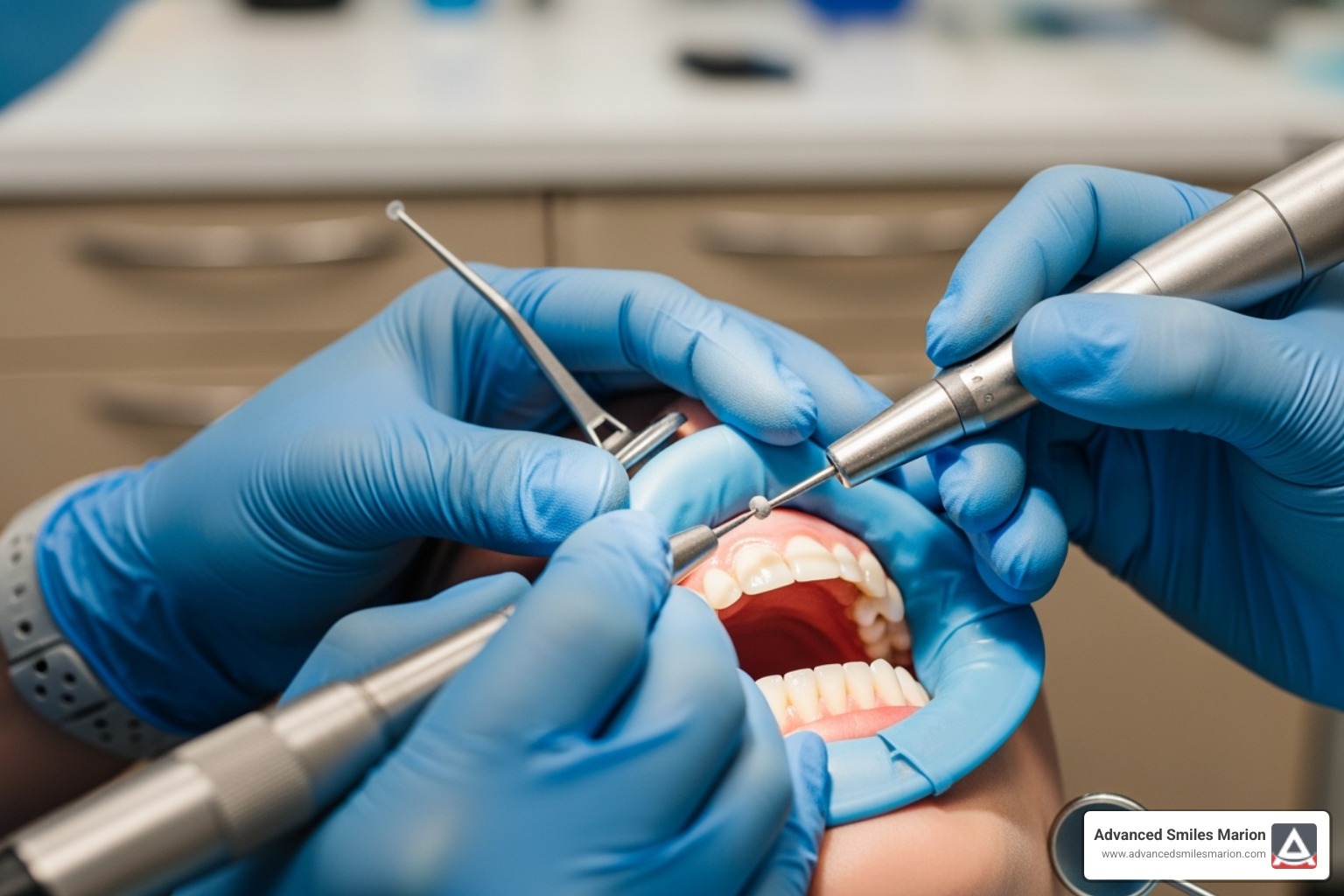
Your crown journey typically unfolds over two visits to our Marion office. During your first appointment, we'll carefully prepare your tooth by removing any decay and gently reshaping it to create the perfect foundation for your new crown. This preparation ensures your crown will fit snugly and securely.
Once your tooth is prepared, we'll take detailed dental impressions - think of this as creating a precise blueprint of your tooth. These impressions are sent to our trusted dental laboratory, where skilled technicians will craft your custom crown to match your natural teeth perfectly.
Before you leave that first visit, we'll place a temporary crown over your prepared tooth. This provisional restoration protects your tooth from sensitivity and keeps your smile looking natural while you wait for your permanent crown to be created.
About two weeks later, you'll return for your final crown delivery appointment. This is where the magic happens! We'll carefully remove your temporary crown and check the fit, bite, and appearance of your new permanent crown. Once we're both happy with how everything looks and feels, we'll permanently bond the crown to your tooth using strong dental cement.
Understanding the ada code for crown delivery for temporary restorations
Those temporary crowns we mentioned? They're more important than you might think, and they have their own specific codes in the dental world.
Provisional crowns are coded as either D2971 for longer-term temporary use (when you might need to wear it for several months) or D2799 for the short-term temporary crown placed right after your tooth preparation. These aren't just placeholders - they're doing serious work protecting the prepared tooth while maintaining your ability to eat, speak, and smile confidently.
Your temporary crown serves as a guardian for your prepared tooth, shielding it from bacteria and temperature sensitivity. It also helps maintain proper spacing between your teeth and keeps your bite aligned during the waiting period. Think of it as your tooth's bodyguard until the permanent crown arrives!
Taking good care of your temporary crown is crucial - you'll want to avoid sticky foods and be gentle when flossing around it. For detailed guidance on caring for both temporary and permanent crowns, check out our Dental Crown Care resource.
Supporting Procedures: Buildups and Posts
Sometimes, before we can place a crown, your tooth needs a little extra help to create a strong foundation. These supporting procedures ensure your crown will have the tooth structure and retention it needs to last for years.
A core buildup (D2950) becomes necessary when significant tooth structure is missing due to decay or damage. We essentially rebuild your tooth's foundation, creating a stable base that can properly support your crown. This isn't just filling in small gaps - it's reconstructing substantial portions of your tooth to ensure long-term success.
For teeth that have undergone root canal treatment, we sometimes need to place a post and core (D2954). The post acts like a reinforcing rod that extends into the root canal, providing additional support for the core buildup that goes on top. This combination creates a rock-solid foundation for your crown.
Our experienced team understands that insurance bundling can sometimes make coverage for these procedures confusing. Some dental plans bundle buildups with crowns, while others cover them separately. We'll work with you to understand your benefits and explain why any supporting procedures are clinically necessary for your specific situation.
If you're curious about the relationship between root canal therapy and crowns, our Root Canal Treatment & Crown page provides detailed information about why crowns are often recommended after root canal treatment.
Frequently Asked Questions about Crown Codes and Insurance
We know that navigating dental insurance can feel overwhelming, especially when you're already dealing with the stress of needing dental work. Our team at Advanced Smiles Marion fields these questions every day, and we're here to help you understand how crown codes and insurance work together.
What is the ada code for crown delivery if my existing crown needs repair?
Sometimes life happens - you bite down on something hard, or your crown simply shows wear after years of faithful service. The good news is that not every crown issue requires a complete replacement.
When an existing crown chips or fractures, the ada code for crown delivery repair is D2980. This code specifically covers repairs to single natural tooth crowns due to restorative material failure, such as fractured porcelain. The repair involves using restorative materials to fix the existing crown rather than replacing it entirely.
D2980 only applies to single crown repairs. If you have a bridge that needs repair, that's a different code (D6980). And if you just need to close an access hole from endodontic treatment, that typically uses a standard restorative code instead.
If your crown simply comes loose - which happens more often than you might think - the code for recementing a crown is D2920. This straightforward procedure reattaches an otherwise healthy crown that has lost its bond to the tooth.
When submitting insurance claims for crown repairs, including a clear narrative describing what happened and pre-treatment photos can help speed up the approval process. For the most current information on CDT codes, the current CDT Coding manuals are available at the ADA Store Homepage.
Why was my crown claim denied or only partially paid?
Few things are more frustrating than expecting your insurance to cover a procedure, only to receive a denial or partial payment notice. While our knowledgeable team works hard to help you understand your benefits upfront, several factors can affect crown coverage.
Frequency limitations are one of the most common culprits. Many dental plans only cover crowns on the same tooth once every five to seven years. If you had a crown placed recently and need another one, your plan might not provide benefits yet.
Plan exclusions can also impact coverage. Some insurance plans exclude coverage for crowns they consider cosmetic, even when they serve important functional purposes. Others may exclude certain materials or limit coverage to less expensive alternatives.
The practice of bundling procedures sometimes catches patients off guard. Insurance companies may consider supporting procedures like core buildups (D2950) as part of the crown procedure itself, refusing to pay separately for both. While the ADA has policies against this practice when procedures are truly separate, plan designs vary widely.
Missing documentation frequently leads to claim delays or denials. Crown claims often require supporting materials like pre-operative X-rays and detailed explanations of why the crown is medically necessary. Without proper documentation, even legitimate claims may be rejected.
Some plans operate on a least expensive alternative basis, covering only the cost of the most basic treatment option, even when your dentist recommends a more durable or appropriate solution for your specific needs.
Don't forget about waiting periods and deductibles either. Many plans require you to wait several months before major procedures are covered, and you'll need to meet your annual deductible first.
Our experienced administrative team understands these insurance complexities and works diligently to help you steer your specific benefits. We believe in transparency and will always discuss potential coverage issues before beginning treatment.
Are veneers and crowns coded the same?
This is a great question that highlights an important distinction in dental treatment. Veneers and crowns serve different purposes and definitely have different CDT codes, even though both can dramatically improve your smile.
Crowns provide full coverage restoration, encasing the entire tooth to restore both structure and appearance. They're the go-to solution when a tooth has significant damage, decay, or has undergone root canal treatment. The preparation involves reshaping the tooth on all surfaces to accommodate the crown.
Veneers, on the other hand, are thin shells that typically cover just the front surface of teeth. They're primarily a cosmetic solution for minor imperfections like discoloration, small chips, or slight spacing issues. The tooth preparation is much more conservative, usually involving only the front surface.
Because these treatments are fundamentally different, they use separate CDT codes. A porcelain veneer might be coded as D2962 for a resin laminate veneer done chairside, or D2960 for a laboratory-made porcelain veneer.
Understanding this distinction matters for both clinical appropriateness and insurance coverage. While crowns are often covered as restorative procedures, veneers may be considered cosmetic and have limited or no coverage under many dental plans.
Our highly trained dentists excel at both crown and veneer procedures and can help you determine which option best meets your needs and goals. For a detailed comparison of these treatments, check out our comprehensive guide on Veneers vs. Crowns: Expert Insights from Marion's Top Dentists.
Partnering for Your Best Smile in Marion, OH
At Advanced Smiles Marion, we believe that informed patients make the best decisions about their oral health. Our commitment is to provide world-class, affordable dental solutions custom to each patient, ensuring you receive comprehensive family care and wellness plans right here in Marion, OH.

Our expert dentists are not just highly educated; they are deeply involved in the community and committed to staying at the forefront of dental advancements. From routine check-ups and cleanings to advanced procedures like Invisalign, TMJ pain treatment, and dental implants, our team is dedicated to providing personalized care. We offer endosteal dental implants, with an average cost of about $4500 per tooth, providing a durable and aesthetic solution for missing teeth. We also feature cutting-edge laser treatments for TMJ pain, canker sore healing, and periodontal disease, bringing you the latest in comfortable and effective care.
We understand that navigating dental insurance can be challenging. That's why we're here to help you every step of the way, from understanding the ada code for crown delivery to maximizing your benefits. For individuals or families without insurance, our Dental Wellness Plan offers discounted prices for yearly dental care, now including two fluoride treatments per year, ensuring everyone can access the quality dentistry they deserve. And for those unexpected moments, we provide emergency dental treatments, often seeing patients on the same day.
We are passionate about restoring not just smiles, but confidence. If you have questions about the dental crown process, your insurance benefits, or any other aspect of your oral health, please don't hesitate to contact us today. Let us help you achieve and maintain your healthiest, happiest smile.

Panel 6: Hope on the Horizon
The mural culminates in a vision of Marion's future, one marked by technological advancements, sustainability, and community togetherness. The cardinal, elevated above a futuristic cityscape, looks ahead with optimism, its backdrop a blend of colors signifying hope.
Get in touch
Have any questions? Want to learn more?


